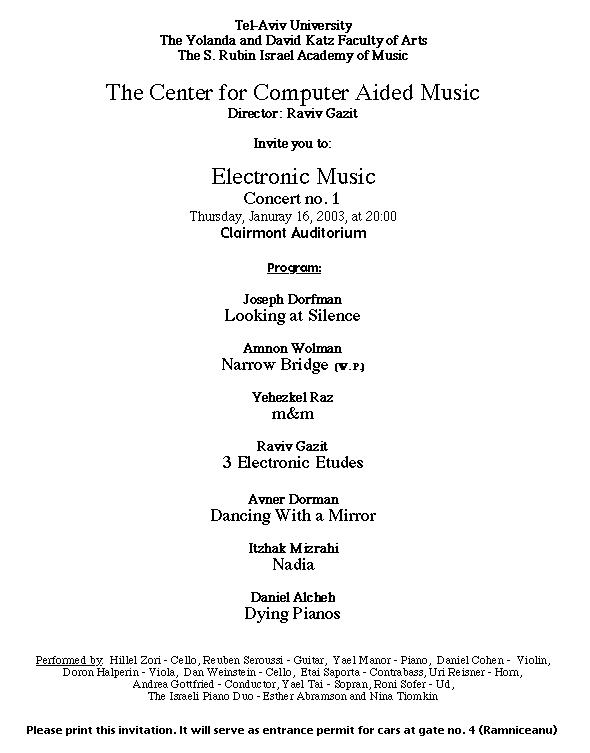
“Dying Pianos” - for piano duo and recorded sound (2002) is constructed of a prologue and 9 sections, each 15 seconds shorter then the one before it. Thus the first section is 120 seconds in length and the last one “0 seconds”. The inner clock, or beat, is the second, and the piece is written in a tempo of Quarter Note = 60 BPM. The score of the piece is divided into 15-second bars. Almost all the pre-recorded, electronic material is derived from the piano material, whether pitch-centric or sonically manipulated soundscape. The recorded material also contains two percussion instruments which play throughout: claves and bass drum (Gran Cassa). The claves are in a way the pieceʼs metronome and sound exactly every 15 seconds. They therefore play 9 times on the first section, and once - as time contracts to zero - on the last section. The Bass Drum has its own take on time. It constantly plays three times in every section: once on the first beat, once exactly in the middle and once on the last beat. This results in its three-beats-per-section contracting one towards the other all the time. In the last “one beat/zero seconds” section they form a tight triplet. Beneath this tapering structure there can be found an obscured, underlying structure of prologue-exposition-transition-development-recapitulation-
cadenza-coda.
The piece can also be played with two live percussion players.
Technical Notes:
The recorded part is to be played using a CD player, a DAW or a cueing application.
Mise-en-scène:
For performance, the pianists are advised to play facing the audience (either in a way creating one long keyboard or separated slightly and angled out), which will produce better balance and dispersion of sound and will facilitate eye and hand communication between the players (see suggested stage arrangement in the score). Both the audience side of the hall and the stage should be as dark as possible. The players should preferably use small clip-on lamps on the pianosʼ note rest or similar ones used in orchestra pits. The 2 grand pianos should give the impression of 2 large graves. Speaker placement should be carefully planned, given the size, shape and acoustic characteristics of the hall. The audience should be immersed in sound and so sometimes a configuration of more than just front-facing stereo speakers should be used, if available. In cases where a simple stereo configuration is used, a good loudspeaker placement might be avoiding placing them at far corners of the stage, creating a stereo separation that is too wide. In certain cases feeding some of the piano sound into the speakers might be effective. The players might request small monitors by their sides (see score for diagram).